
Why is warehouse Wi-Fi different from office Wi-Fi?
A warehouse isn't an oversized office.
High ceilings, metal racks, machinery, inventory, insulated areas, concrete walls, loading zones, and large distances create a much different environment for wireless coverage.
The network may also need to support far more than laptops and phones. Depending on the facility, Wi-Fi and the underlying network can support operational devices, cameras, access control systems, office users, scanners, and other connected equipment.
That means reliable coverage needs to be planned around how the building actually operates.
Are access points located where connectivity is needed?
Adding more access points isn't automatically the answer to weak Wi-Fi.
Placement matters.
An access point installed where cabling was easiest to reach may not provide useful coverage where employees or connected systems actually need it. Warehouses can have tall racks, changing inventory, equipment, walls, and other physical obstacles between an access point and its users.
A better starting point is identifying where reliable connectivity is actually required.
That may include:
Receiving and shipping areas
Production floors
Offices
Loading docks
Inventory and storage areas
Controlled entrances
Exterior work areas
Once those requirements are clear, access points and the infrastructure supporting them can be planned accordingly.
Has the facility outgrown its original network?
Commercial facilities rarely stay exactly the same.
A warehouse adds another storage area. A manufacturer installs new equipment. An office expands into another part of the building. More cameras are added. A previously unused space becomes part of daily operations.
The Wi-Fi system that served the original layout may no longer match the facility.
Before replacing equipment, it helps to compare the current network with the way the building is being used today.
Where are employees experiencing problems?
What has been added since the network was designed?
Which areas now depend on connectivity that didn't before?
Those questions can reveal whether the problem is wireless coverage, network capacity, cabling, equipment location, or a combination of several issues.
Could the cabling be part of the problem?
Wireless networks still depend on wired infrastructure.
Access points need reliable connections back to the network, which makes structured cabling an important part of commercial Wi-Fi performance.
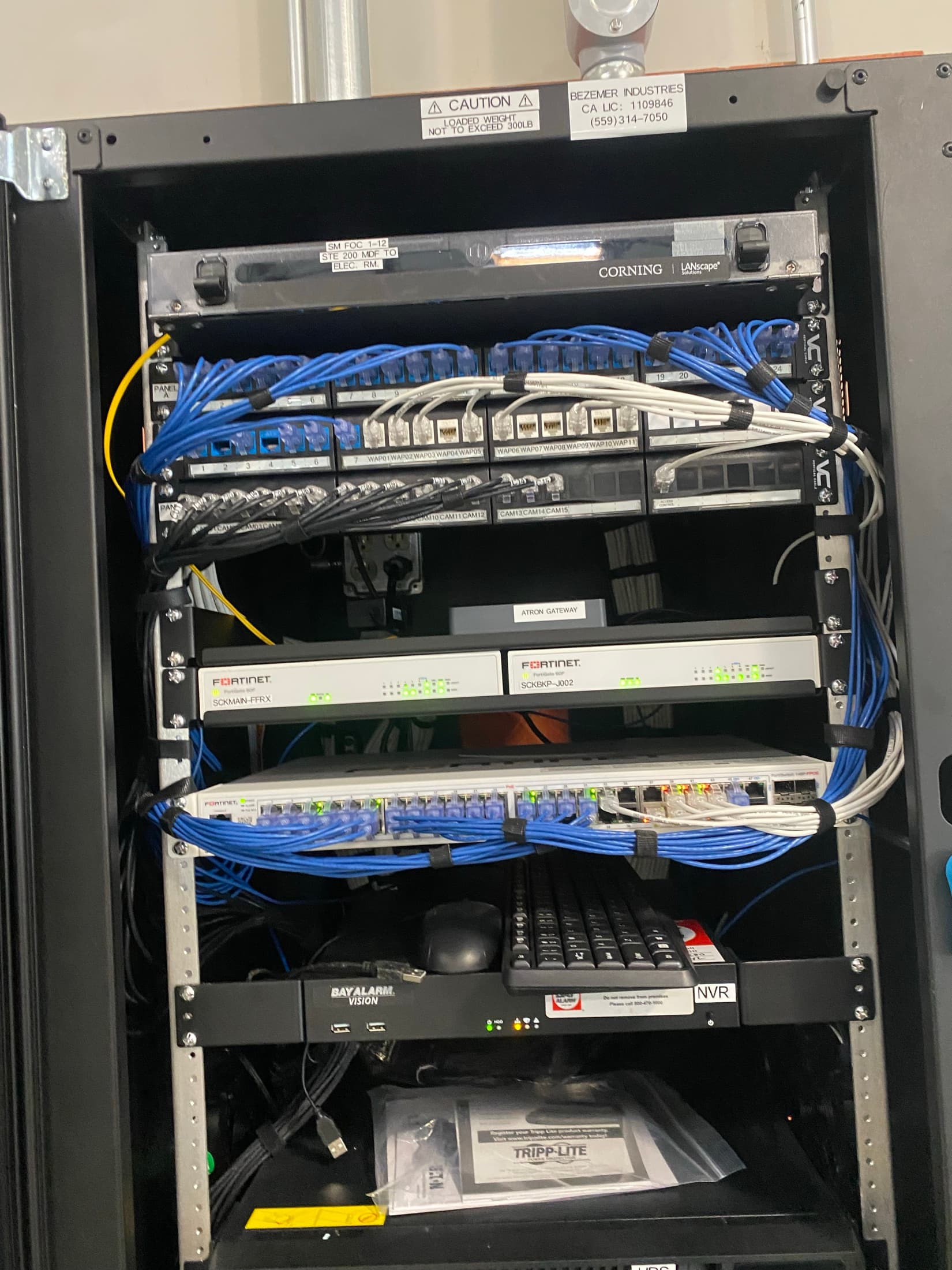
Old, damaged, poorly routed, or undocumented cabling can make network problems harder to diagnose. So can crowded network closets and infrastructure that has been modified repeatedly without clear labeling.
When commercial Wi-Fi is being upgraded, the existing cabling should be part of the assessment.
Bezemer's commercial structured cabling work includes organized racks, tested and labeled drops, and documentation designed to make the infrastructure easier to maintain.
When does distance call for a fiber backbone?
Large warehouses, manufacturing plants, yards, and multi-building properties create another challenge: distance.
Trying to serve an entire property from one network location may not be practical. Some facilities need additional network locations or a backbone connecting different sections of the property.
This is where fiber optic cabling may become part of the conversation.
Fiber can be used to connect network rooms, remote switches, detached buildings, camera networks, access control areas, and other distant parts of a commercial property.
The goal isn't to install fiber everywhere. It's to determine where the facility's distances and infrastructure requirements make a stronger backbone necessary.
What happens as more devices join the network?
Commercial networks tend to grow one project at a time.
First there are office computers and phones. Later, additional Wi-Fi access points are installed. Then commercial security cameras are added. Access control expands. Another part of the facility comes online.
Each individual project may seem manageable, but eventually the infrastructure supporting all of those systems deserves another look.
That's especially important when security and operational systems depend on the same underlying network infrastructure.
Planning those systems together can help identify cabling, switch, backbone, and network requirements before another device gets added.
How do building materials and inventory affect planning?
Warehouses and industrial facilities contain physical conditions that aren't common in a standard office.
Metal structures and racks, machinery, insulation, refrigeration equipment, concrete, and large open areas can all influence how a network should be designed.
Facility layouts also change. A relatively open warehouse during one phase of operation may later be filled with inventory and equipment.
That's one reason commercial Wi-Fi planning should happen in the actual facility instead of being based only on a floor plan.
Does connectivity need to reach docks, yards, or detached buildings?
For some facilities, operations don't stop at the exterior wall.
Employees may need connectivity around docks, gates, yards, detached buildings, or other parts of the property. Cameras and other network-connected equipment may also be located far beyond the main office.
Extending reliable connectivity to those locations may require more than installing another indoor access point near a window.
The network design needs to consider distance, pathways, equipment locations, and the infrastructure required to connect remote areas back to the main network.
What should a commercial Wi-Fi assessment include?
Before purchasing new access points or replacing network equipment, assess the facility as a whole.
Start by identifying the areas that need reliable connectivity, where problems currently occur, what devices depend on the network, and how the property may change in the future.
The assessment should also look at existing cabling, network rooms, switches, access point locations, remote buildings, security systems, and potential expansion.
This makes it easier to separate a Wi-Fi coverage problem from an infrastructure problem.
Why plan Wi-Fi, cameras, and access control together?
Modern commercial facilities depend on systems that increasingly share infrastructure.
Cameras need network connectivity. Access control may depend on connected controllers and equipment. Wi-Fi access points need cabling and network capacity. Remote parts of a facility may require fiber or additional network equipment.
Planning each system separately can create unnecessary limitations later.
Bezemer Industries designs and installs commercial network infrastructure alongside structured cabling, fiber, cameras, access control, and other low-voltage systems for facilities in Clovis, Fresno, and throughout the Central Valley.
Explore Bezemer's network design and Wi-Fi services for commercial facilities.
Start with the building
If employees keep losing connectivity in the same part of the warehouse, cameras struggle in remote areas, or Wi-Fi performance has gotten worse as the facility has grown, adding another piece of equipment without diagnosing the infrastructure may not solve the problem.
Bezemer Industries can assess the network, cabling, access point locations, fiber requirements, and connected low-voltage systems to determine what needs attention and what existing infrastructure may still be useful.
Schedule a commercial site assessment with Bezemer Industries to identify the infrastructure behind your facility's Wi-Fi problems and plan the next practical step.